
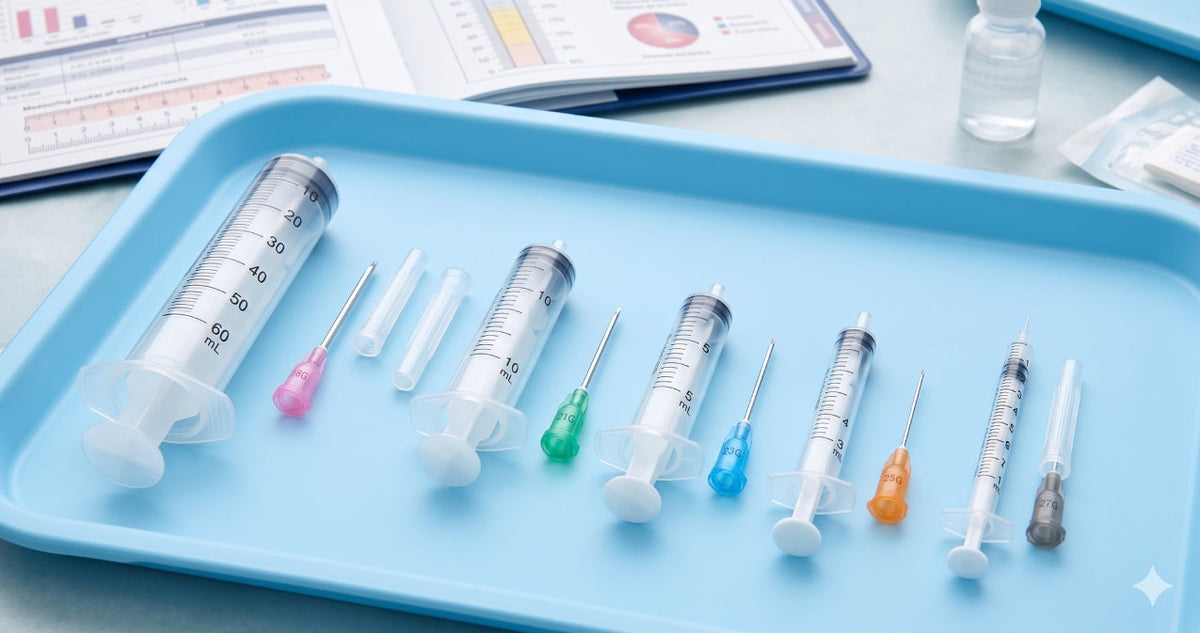
Ordering needles and syringes means comparing two measurements that can seem counterintuitive. Gauge runs backwards, and syringe capacity is not needle size. If the markings seem confusing on a first order, separating them makes comparison easier.
How needle gauge works
Gauge measures the needle's outside diameter, and the scale is inverted: the higher the number, the thinner the needle. An 18-gauge needle is thicker than a 25-gauge one—picture a sturdy straw beside a finer tube. Thinner needles are generally more comfortable, while thicker needles move viscous fluid more easily and draw up medication faster.
Gauge is usually printed on the hub and colour-coded, though colour conventions vary by manufacturer, so read the label rather than relying on colour alone. The BD General Use Hypodermic Needles range shows different gauges and lengths.
Needle length
Length is listed separately, in inches, commonly from 3/8" up to 1 1/2". It is chosen according to the type of injection and the patient's build. Because length affects where medication is deposited, it is set by the prescribing clinician or by the instructions supplied with the medication.
Syringe capacity
Syringe size refers to the volume it holds, not the attached needle. Common capacities run from 1 mL up to 60 mL. Smaller syringes have finer graduation marks, making small volumes easier to measure accurately. Larger syringes suit irrigation, feeding and wound care, where precision at very small volumes matters less. The 60 mL piston irrigation syringe with catheter tip is one large-capacity example.
Some syringes come with a needle fitted; others are sold separately so the needle can be matched to the task. Luer-lock fittings twist on and stay secure under pressure, while luer-slip fittings push on and come apart more easily. For anything delivered under pressure, luer-lock is the safer default.
Putting the two together
A typical order specifies three things: syringe capacity, needle gauge and needle length, in that order. A request for a 3 mL syringe with a 23-gauge, 1-inch needle describes all three. When reordering, read the existing packaging and match it exactly, including the manufacturer, since hub design and graduation marks differ between brands. See what a piston irrigation syringe is and when it is used.
What to confirm before ordering
Check whether your use requires a safety-engineered needle, since many clinical settings mandate them. Confirm sterility and single-use labelling. Check pack quantity, because needles and syringes are usually sold by the box, and counts vary. Related supplies, including medical gloves, are listed separately.
If the product is for a specific medication, verify gauge and length against its instructions before buying in volume. Specifications here are general reference only; selection for any individual should be directed by a qualified healthcare professional. If you have ordered before, our team can help match the product using details on your packaging.
Medical disclaimer
This article is provided for general educational purposes only and does not constitute medical advice, diagnosis or treatment. Product information is general and may not suit every individual's circumstances. Always consult a qualified healthcare provider regarding your specific medical needs before changing any aspect of your care.
Published by the Medical Supply Group Team | medicalsupplygroup.com
Questions? Call us at (800) 278-0227 or email info@medicalsupplygroup.com