The first few days at home with a catheter can bring an unexpected question: why are there two different drainage bags in the box? A leg bag and a night bag both collect urine, but each is designed for a different part of the day. Whether you call it a catheter bag, a Foley catheter bag, a urine drainage bag or a catheter leg bag, this guide explains how they work, how to choose one, and how to empty and change it.
Catheter drainage bags at a glance
- What it does: a drainage bag connects to a catheter through tubing and collects urine by gravity.
- Leg bag: smaller (typically 500 to 1,000 mL), worn on the thigh or calf during the day.
- Night bag: larger (about 2,000 mL), hung at the bedside overnight, always below bladder level.
- Check before ordering: capacity, tubing length, valve type, connector fit and straps.
- Always: follow your nurse’s or provider’s instructions for your setup.
What a urinary drainage bag does
A urinary drainage bag connects to a catheter through tubing and collects urine by gravity. Keeping the system closed helps reduce infection risk. A drain valve at the bottom lets the bag be emptied without disconnecting the system. Capacity is measured in millilitres (mL). Drainage bags are used with indwelling catheters, such as Foley catheters.
Leg bag vs. night bag at a glance
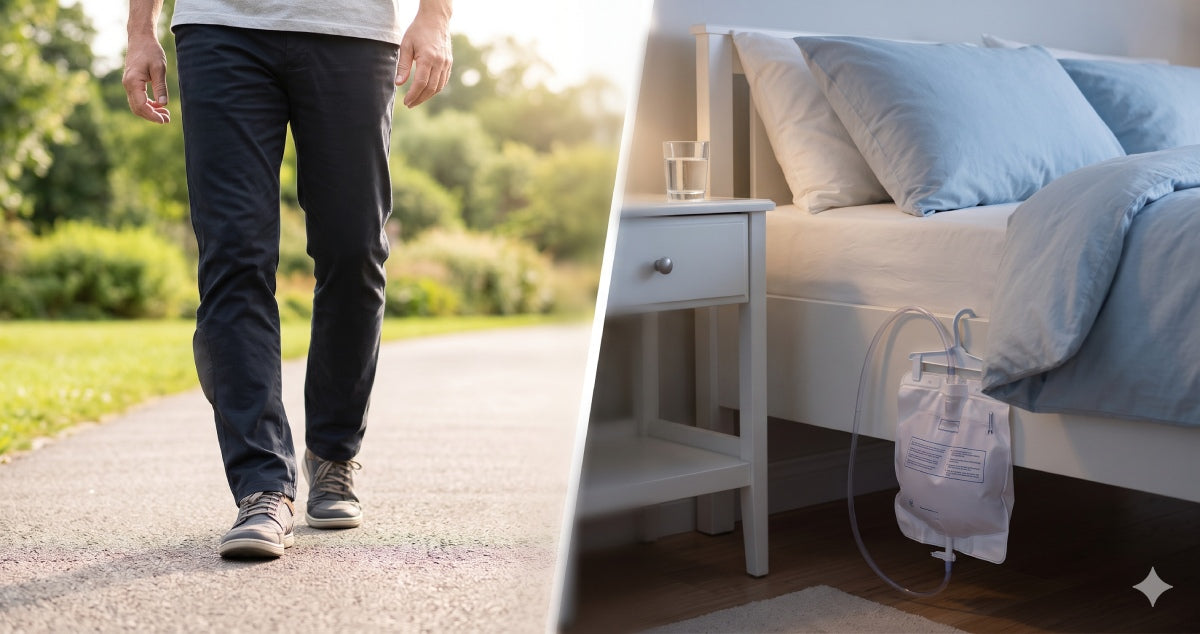
Daytime
Leg bag
Smaller, worn against the thigh or calf, and discreet under clothing. Built for walking and going out.
Overnight
Night bag
Larger capacity, hung at the bedside rather than worn. Built to hold urine overnight.
| Feature | Leg bag | Night bag |
|---|---|---|
| Worn or hung | Worn on the thigh or calf | Hung at the bedside |
| Capacity | About 500 to 1,000 mL | About 2,000 mL |
| Best for | Daytime, walking and going out | Overnight and resting |
| Emptying | More often, because it holds less | Less often |
| Secured with | Straps or a fabric holder | A bedside hook or stand |
| Position | Worn below the bladder | Hung below bladder level |
Leg bags: built for daytime mobility
A leg bag is smaller, typically 500 to 1,000 mL, and is worn against the thigh or calf using straps or a fabric holder. Its compact design sits discreetly under clothing while keeping the collection system close to the body. Because it holds less, it may need emptying more often than a larger bag.
The way it is secured matters, too. Fabric holders spread weight across the leg and may feel more comfortable during extended wear than straps alone, particularly for people with fragile skin. Fit under clothing can affect comfort and discretion. Examples include the Bard Dispoz-A-Bag leg bag with Flip-Flo valve, EasyTap leg bags, the TruCath flocked-back leg bag and the leg bag with flip drain. Browse disposable leg bags and reusable leg bags.
Night bags: built for overnight capacity
A night bag holds considerably more, commonly around 2,000 mL, and is designed for bedside use rather than wearing. It hangs from a bedside frame or hook and must remain below bladder level, which helps prevent backflow. An example is the Bard bedside drainage bag with anti-reflux chamber. See all urinary drainage bags.
Using both in a daily routine
Many people use a leg bag during the day and a night bag overnight. The bags may be switched, or the night bag may connect to the leg bag’s outlet so both work in series. Series connection means fewer disconnections. Your nurse or supplier can show you the approach that suits your setup.
What to check before ordering
| Check | Why it matters |
|---|---|
| Capacity | Leg bags and night bags hold different amounts |
| Tubing length | Tubing that is too short can restrict movement; excess length can kink. Extension tubes are available. |
| Valve type | A flip-flo style valve is usually easier to manage with limited hand strength than a twist valve |
| Anti-reflux chamber | Helps prevent urine flowing back toward the bladder |
| Connector fit | Confirm that the connector fits your catheter |
| Straps or holder | Fabric holders can be gentler on the skin, and non-slip straps keep the bag in place |
| Single-use or reusable | Reuse periods vary by manufacturer, so follow the instructions supplied with your product |
If you are unsure about compatibility or connections, ask your nurse or supplier for help.
How to empty a catheter bag
- Wash your hands.
- Hold the bag over the toilet or a clean container, below bladder level.
- Open the drain valve without letting the spout touch the toilet or container.
- Let the urine drain, then close the valve firmly.
- If your nurse advises, wipe the spout with an alcohol wipe.
- Wash your hands again.
How to switch between a leg bag and a night bag
Your nurse will show you the technique for your setup. In general, wash your hands, keep the connection ends clean and avoid touching them, connect the new bag firmly, and make sure the tubing is not kinked.
How often should a catheter bag be changed?
It depends on the product and your care plan. Reuse periods vary by manufacturer, so follow the instructions supplied with your bag and your nurse’s advice. Replace a bag sooner if it is damaged, leaking or smells.
Leg bag straps, holders and accessories
Straps keep the leg bag in place: non-slip catheter leg straps, wide reusable straps and fabric holders. Extension tubes give extra length. Browse leg bag holders and straps.
When to call your provider
Catheter drainage bags: frequently asked questions
▾What is a catheter leg bag?
A catheter leg bag is a small drainage bag worn against the thigh or calf, usually with straps or a fabric holder. It collects urine from an indwelling catheter during the day.
▾What is the difference between a leg bag and a night bag?
A leg bag is smaller and worn during the day. A night bag holds more, about 2,000 mL, and hangs at the bedside overnight.
▾What size leg bag do I need?
Leg bags typically hold 500 to 1,000 mL. A smaller bag is more discreet but needs emptying more often. Your nurse can help you choose.
▾How do I empty a catheter bag?
Wash your hands, hold the bag over the toilet or a clean container below bladder level, open the drain valve without letting the spout touch anything, let the urine drain, close the valve and wash your hands again.
▾How often should I empty a catheter bag?
Empty it before it becomes full or heavy. A leg bag needs emptying more often than a night bag because it holds less.
▾How often should I change a catheter bag?
It depends on the product. Reuse periods vary by manufacturer, so follow the instructions supplied with your bag and your nurse’s advice.
▾Why must the bag stay below the bladder?
Urine drains by gravity. Keeping the bag below bladder level helps urine flow into the bag and helps prevent it flowing back toward the bladder.
▾Can I wear a leg bag at night?
Most people switch to a larger night bag overnight, because a leg bag fills quickly. Ask your nurse what is right for you.
▾Can I wear a leg bag under clothing?
Yes. Leg bags are designed to sit discreetly under clothing. Fit and tubing length can affect comfort, so choose the right size and secure it with straps or a holder.
▾What is an anti-reflux valve or chamber?
It is a feature in the bag that helps stop urine flowing back up the tubing toward the bladder.
▾Are catheter bags covered by insurance?
Many plans cover catheter supplies when they are medically necessary. Coverage varies, so check your benefits.
Shop drainage bags at Medical Supply Group
See the Bard catheter and drainage range, the wider urological collection, or our intermittent catheter guide for related information.


Browse more:
Drainage bagsDisposable leg bagsReusable leg bagsLeg bag holders & strapsFoley cathetersIntermittent catheters
Need help matching a drainage bag to your catheter?
Tell us what catheter you use and our team will help you find a compatible leg bag or night bag.
Call (800) 278-0227Shop drainage bagsPublished by the Medical Supply Group Team | medicalsupplygroup.com
Last reviewed: November 2026
Questions? Call us at (800) 278-0227 or email info@medicalsupplygroup.com